
https://www.fmdnqi.com/the-ultimate-guide-to-dell-ultrasharp-monitors-6k-performance-and-ipps-innovation/
Introduction: The world’s first ipPSbl enhanced screen, is Dell 12715QE worth looking forward to?
With the continuous advancement of display technology, the color performance and refresh rate of the display have become important indicators for measuring the experience. Dell’s newly released 12715QE display uses the world’s first ipPSbl enhanced panel, claiming to increase the typical 1000:1 contrast ratio to an astonishing 3000:1. This article will reveal the true performance of this display through detailed testing to see if it can meet the expectations of designers, gamers and high-end office users.
Unboxing and design details: minimalist style and practical interface coexist
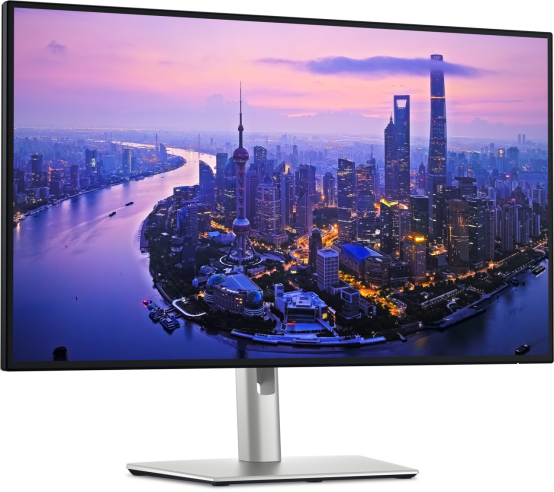
The packaging continues Dell’s usual black color scheme design, with a display rendering printed on the box. After opening, all accessories are available: power cord, DisplayPort cable, Thunderbolt cable, Type-C to USB cable, and instruction manual. The installation process is simple, the base is connected by screws and buckles, and the ultra-narrow bezel design on all four sides makes the screen look great. The micro-bezel with nearly equal width on all four sides is undoubtedly a boon for “obsessive-compulsive” users.
The base adopts a fan-shaped design, which takes up little desktop space. The back is equipped with a light sensor that supports automatic adjustment of brightness and color temperature. It has a rich interface, including HDMI, DisplayPort input and output, multiple USB-C and USB-A interfaces, audio output and Ethernet port. In particular, the pop-up module design hidden at the bottom further expands the number of interfaces, almost comparable to the 10,000-yuan Thunderbolt docking station.
The bracket supports lifting, pitching, horizontal and vertical rotation. The resistance is moderate but the stability is lower than the previous generation, which is a bit regrettable.
Panel and picture quality: transparent and delicate, with satisfactory color coverage
The Dell logo is displayed when the computer is turned on. The first impression is that the picture is transparent and not greasy, and the colors are bright but not oversaturated. After testing, its sRGB color gamut coverage reaches 134%, and the refresh rate is increased from the traditional 60Hz to 120Hz, giving the monitor a certain “micro-gaming” attribute.
The panel uses the LM270WRA model provided by LGD, with clear and delicate pictures, sharp fonts, and reduced color fringing. The menu operation is realized through 5 remote sensing buttons, with clear logic and comprehensive functions, including built-in color test reports.
Automatic brightness and color temperature adjustment is smooth and natural, without obvious jumps. The color temperature is close to the standard D65 white point in many places, and the sRGB, BT.709 and DisplayP3 color gamut coverage are all excellent, with an average color difference as low as 0.6 and a maximum color difference of about 2.0, which is a high level for professional monitors.
Brightness and contrast: Officially 3000:1, but actually more complicated
The default brightness when powered on is about 160 nits, which can be adjusted to a maximum of 402 nits. The brightness uniformity is average, and the maximum brightness difference reaches 25%, which is slightly insufficient in the field of design displays.
In terms of contrast, the official rating is 3000:1, but the actual measurement is about 2500:1 at the default 75% contrast setting; when adjusted to 100%, although it is close to the official value, distortion and overexposure will occur in the white field, especially in office applications (such as Excel and web pages).
The dynamic contrast test showed excellent results, reaching about 18000:1, and the static contrast was also maintained above 2500:1. The black field performance was pure, the zone light control technology performed well, the halo effect was very small, and the picture quality was rich in details.
Viewing angle and light leakage: solid performance but still room for improvement
The viewing angle range is about 20 degrees, which is a medium level. The black field light leakage is well controlled, with the highest peak value of about 0.45 nits, which is within the acceptable range. In terms of color temperature uniformity, there are slight fluctuations in the edge area, but the overall performance is still stable.
High-frequency PWM dimming and blue light risks: eye protection design deserves recognition
The monitor uses high-frequency PWM dimming (about 20,000 Hz), with a stable waveform, which effectively reduces visual fatigue. The peak wavelength of blue light is 455 nanometers, and short-wave blue light accounts for 7.25%, which belongs to the hardware low blue light level and is suitable for long-term use.
Interface performance and compatibility: powerful expansion to meet diverse needs
The DisplayPort interface supports 4K@120Hz 10-bit and 12-bit HDR, and the Thunderbolt interface supports up to 140W power supply. After connecting to the computer, the 4K@120Hz signal delay is about 17.8 milliseconds, which is good performance. The interface is rich and practical, providing sufficient support for daily multi-device connection and power supply.
Actual response and gaming experience: 120Hz refresh rate brings smooth pictures
In actual tests, there is no frame skipping at 120Hz refresh rate. The response time is about 11.9 milliseconds in standard mode, with no obvious ghosting, and the fast mode response is increased to 8.2 milliseconds, but with slight ghosting. Taking all factors into consideration, the fast mode is the recommended setting for gamers.
There is a certain amount of trailing and blurring in the motion picture, which is in line with the characteristics of the IPS panel. Although it is not top-level for e-sports, it is sufficient for design and light gaming users.
Internal structure and component analysis: high-specification components ensure stable performance
Disassembling the interior of the monitor, it is found that it uses a metal shielding cover, the main control chip is MediaTek MT9801, the interface expansion is handled by the Swiss FL5801 chip, and the audio and network port chips are from well-known manufacturers in the industry. The overall workmanship is solid.
The official specifications of the panel are 27-inch 4K resolution, 120Hz refresh rate, 99% DCI-P3 color gamut coverage, 14 milliseconds response time, support for hardware-level low blue light and a contrast ratio of at least 2400:1 and up to 3000:1.
Summary of advantages and disadvantages: Strong performance, some details still have room for improvement
advantage:
The first ipPSbl enhanced panel, with refresh rate increased to 120Hz, for a smoother experience
Ultra-narrow frame design with nearly equal width on all four sides, providing excellent visual enjoyment
Wide color gamut coverage, accurate colors, and support for hardware low blue light
Up to 8-zone light control design, pure black field, excellent dynamic contrast
Rich interface configuration, including Thunderbolt 4 and 140W power supply, to meet the needs of connecting multiple devices
shortcoming:
The brightness uniformity is poor, with the maximum difference reaching 25%. There is still room for improvement in the design standards of monitors.
The stability of the bracket is slightly weaker than the previous generation, and the shaking feeling is obvious
Although high-frequency PWM dimming reduces fatigue, there is still room for further optimization
Conclusion: Who is Dell 12715QE suitable for?
Overall, Dell 12715QE is a high-end monitor with balanced performance and exquisite design details, especially suitable for designers, creators and users who want to take into account light gaming experience. Although there are some shortcomings in brightness uniformity and bracket stability, its color performance and interface configuration are still at the forefront of the industry. If you are looking for a 4K high refresh rate and accurate color professional monitor, Dell 12715QE is undoubtedly worth paying attention to.
Everyone is welcome to leave a message to share your views or questions about this monitor. We will continue to pay attention and bring more in-depth evaluation content.
https://www.fmdnqi.com/the-ultimate-guide-to-dell-ultrasharp-monitors-6k-performance-and-ipps-innovation/